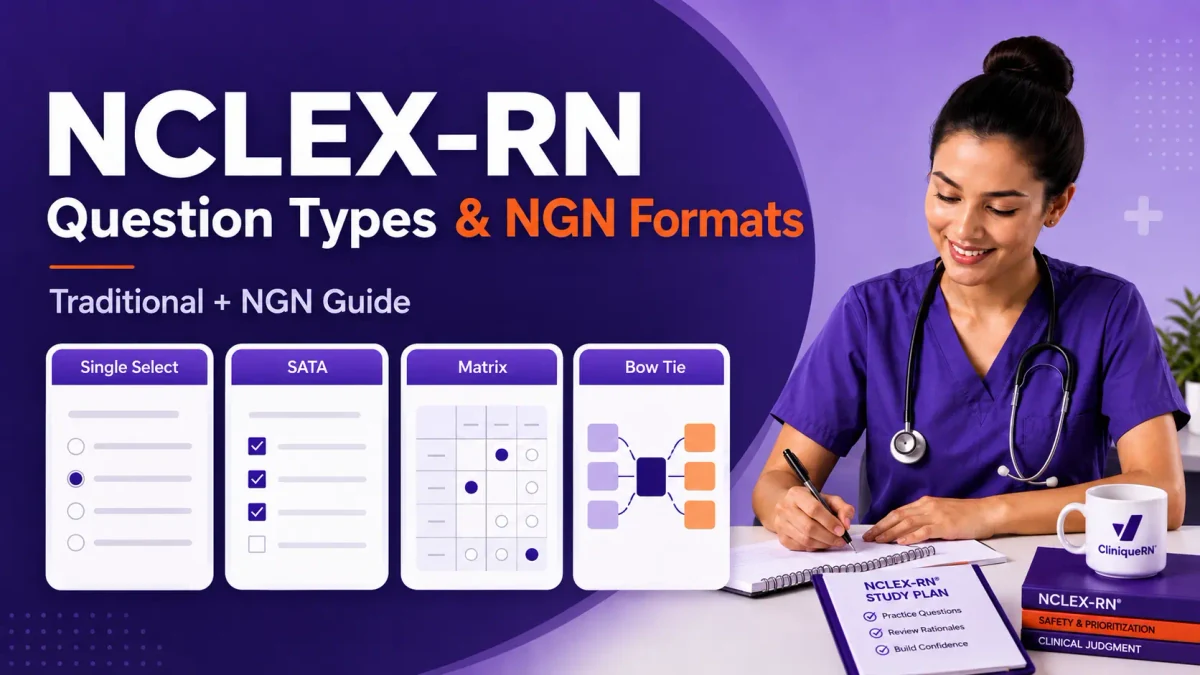
NCLEX-RN Question Types & NGN Formats Explained
If you are preparing for the NCLEX-RN and the newer question formats feel confusing, you are not alone. The Next Generation NCLEX launched on April 1, 2023 to better measure clinical judgment and decision-making, which means students now need to recognize both Traditional NCLEX formats and newer NGN-style items.
This guide explains the major NCLEX-RN question types you may see on test day, including Single Select, SATA, Bow Tie, Matrix, Drop-down Cloze, Drag & Drop, Highlight, and Select N formats. You will also learn how each format works, how scoring may apply, and how to practice each type more effectively.
The Simplest Way to Think About NCLEX-RN Formats
- Traditional questions usually test your ability to choose the best answer
- NGN questions often test how you connect cues, decisions, actions, and outcomes in patient care
- Traditional formats are still on the exam — NGN added new types, it did not remove the old ones
- Some NCLEX item types can award partial credit when more than one response or linked response is scored, so answering carefully matters more than ever
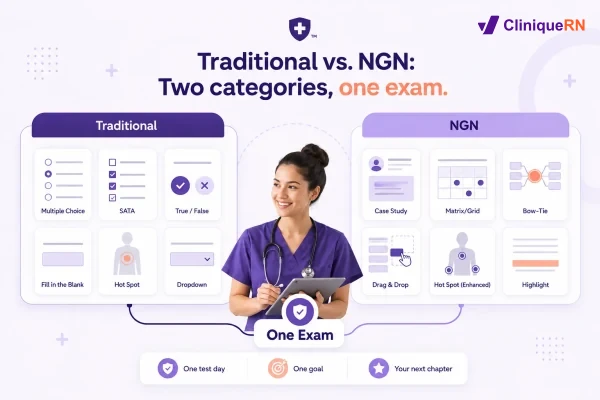
Traditional vs. NGN: Two categories, one exam
The NCLEX-RN now combines Traditional formats you have studied in school with Next Generation formats designed to measure clinical judgment. Every format has its own screen layout, scoring rule, and approach strategy — knowing the differences before test day removes the surprise and lets you focus entirely on the clinical reasoning.
Quick Reference: NCLEX-RN Question Types
| Question Format | Type | Practice |
|---|---|---|
| Single Select | Traditional | |
| Select All That Apply (SATA) | Traditional | |
| Single Select with Image | Traditional | |
| SATA with Image | Traditional | |
| Drop-down Cloze: 1 Cause & 2 Effects | NGN | |
| Drop-down Cloze Select N | NGN | |
| Matrix Single Select | NGN | |
| Matrix Multi Select | NGN | |
| Drag & Drop: 1 Cause & 2 Effects | NGN | |
| Drag & Drop Cloze Select N (Into Table) | NGN | |
| Drag & Drop Cloze Select N (Into Sentence) | NGN | |
| Drag & Drop Cloze SATA | NGN | |
| Highlight Text | NGN | |
| Highlight Table | NGN | |
| Select N | NGN | |
| NGN Single Select | NGN | |
| NGN SATA | NGN | |
| Bow Tie | NGN |
What Changed With the Next Generation NCLEX?
The Next Generation NCLEX, often called NGN, launched on April 1, 2023. The goal was not just to add new question screens. The bigger goal was to better measure how nursing candidates use clinical judgment when caring for patients.
Traditional NCLEX-style questions are still part of the NCLEX-RN. You can still see Single Select questions, SATA questions, and questions that include images or exhibits. NGN did not remove those older formats. It added newer item types designed to test how you recognize cues, analyze information, prioritize care, take action, and evaluate outcomes.
The biggest change is scoring. Some NGN questions can award partial credit because they contain more than one correct part. That means your strategy should not be only "all right or all wrong." You need to understand how each format works so you can answer carefully and avoid losing points from extra unsupported selections.
Traditional NCLEX Question Formats
Traditional NCLEX question formats are the item types most nursing students have seen throughout school and in traditional question banks. These formats usually focus on choosing the best answer, identifying correct options, or interpreting a visual cue.
Single Select
A single-select multiple choice question gives you one question stem and several answer options, with one best answer.
How it looks: You will usually see a short clinical scenario or direct question followed by answer choices. You choose only one option before moving forward.
How to approach it: Read the question carefully before looking at the answers. Try to predict what the question is asking before reviewing the options. Then eliminate clearly wrong answers and choose the option that best matches the client's priority need.
Select All That Apply (SATA)
A SATA question asks you to choose every option that is correct — there is no fixed number of correct answers.
How it looks: You will see a question stem followed by a list of answer options. More than one option may be correct.
How to approach it: Treat each answer choice like a separate true-or-false statement. Do not assume there must be a certain number of correct answers. Focus only on whether each option is supported by the question.
Single Select With Image
A single-select image question works like normal multiple choice but includes a visual such as a wound image, ECG strip, IV setup, or clinical diagram.
How it looks: You will see an image along with the question stem and answer options. The image contains important information needed to answer the question.
How to approach it: Describe the image to yourself in simple words before choosing an answer. Ask: What do I see? What is abnormal? What does this finding suggest? Then connect the image to the question stem.
SATA With Image
A SATA with image question combines visual interpretation with select-all-that-apply logic.
How it looks: You will see an image, a clinical question, and multiple answer choices. More than one option may be correct.
How to approach it: First interpret the image. Then evaluate each answer choice one by one. Do not let one correct-looking answer influence the rest of your choices.
Next Generation NCLEX Question Formats
NGN question formats are designed around clinical judgment. Many are connected to case studies, lab values, provider orders, nurses' notes, medication records, or changes in client condition over time. Understanding the clinical judgment process helps you approach every NGN item more systematically.
The NCSBN Clinical Judgment Measurement Model (NCJMM): 6 Steps
- Recognize cues — identify relevant client findings from the data provided
- Analyze cues — determine what those findings mean clinically
- Prioritize hypotheses — decide which condition or problem is most likely
- Generate solutions — identify what actions could address the problem
- Take action — select and implement the most appropriate intervention
- Evaluate outcomes — assess whether the action improved the client's condition
Not every NGN question tests all six steps, but many formats require you to connect more than one step before choosing an answer. NCJMM is the official NCSBN framework used to measure clinical judgment and decision-making on the NCLEX-RN.
Drop-down Question Formats
Drop-down Cloze: 1 Cause & 2 Effects
A Drop-down Cloze question asks you to complete a sentence or clinical statement by choosing answers from drop-down menus.
How it looks: You may see a sentence with one or more blanks. Each blank has a drop-down list of possible answers.
How to approach it: Read the full sentence first without selecting anything. Then identify what each blank is asking for. If the sentence is asking for a likely condition, solve that part first before choosing related interventions or outcomes.
Drop-down Cloze Select N
A Drop-down Cloze Select N question is similar to Drop-down Cloze, but it tells you how many selections you need to make.
How it looks: You may see a clinical sentence, table, or paragraph with several drop-down choices. The question specifies how many correct responses to select.
How to approach it: Pay close attention to the number given in the question. If it says select two, choose exactly two. Compare the choices against the client data instead of choosing options that only sound generally correct.
Matrix Question Formats
Matrix Single Select
A Matrix Single Select question presents information in a table where you choose one answer in each row.
How it looks: You may see rows with findings, interventions, or statements. Each row has columns such as "Expected," "Unexpected," "Indicated," or "Not indicated." You select one option per row.
How to approach it: Treat each row as its own mini-question. Do not assume all rows follow the same pattern. Read the row, compare it with the client scenario, and choose the most accurate column.
Matrix Multi Select
A Matrix Multi Select question also uses a table, but each row may allow more than one correct selection.
How it looks: You will see rows and columns like a grid. Unlike Matrix Single Select, more than one box in a row may be correct.
How to approach it: Slow down and evaluate every box independently. Think of each row as a group of related SATA decisions. Use the client data to support every selection.
Drag & Drop Question Formats
Drag & Drop: One Cause & 2 Effects
A Drag & Drop Cloze question asks you to drag answer options into blanks or target areas in a sentence or clinical statement.
How it looks: You may see a sentence, paragraph, or clinical statement with empty spaces. You drag the correct options into those spaces.
How to approach it: Read the entire sentence before dragging options. Identify what each blank represents — condition, intervention, or expected outcome. Then place answers in an order that creates a clinically accurate statement.
Drag & Drop Cloze Select N (Into Table)
A Drag & Drop Cloze Select N question asks you to drag a specific number of options into a table column in priority order.
How it looks: You will see a table with a source column of options and a target priority action column. You drag only the requested number of items across.
How to approach it: First remove options that are clearly unrelated. Then compare the remaining choices and select only the number requested. Prioritize the options that directly match the client's most urgent problem.
Drag & Drop Cloze Select N (Into Sentence)
A Drag & Drop Cloze Select N question asks you to drag a specific number of options into inline blanks within a sentence.
How it looks: You will see a clinical sentence with numbered blanks and a list of word choices to drag into position.
How to approach it: Read the full sentence first to understand the clinical context. Then fill each blank in order, checking that the completed sentence makes clinical sense.
Drag & Drop Cloze SATA
A Drag & Drop Cloze SATA question combines drag-and-drop logic with select-all-that-apply thinking.
How it looks: You may need to choose multiple correct options from a list and drag them into a response area.
How to approach it: Evaluate each option independently before dragging it. Ask whether the option is directly supported by the client's data. If it is only generally related but not clinically supported, leave it out.
Highlight Question Formats
Highlight Text or Table
A Highlight question asks you to select important words, phrases, findings, or table cells from the information provided.
How it looks: You may see a paragraph, nurse's note, lab report, medication record, or table. You click or tap the parts of the text or table that answer the question.
How to approach it: Read the question first so you know what you are looking for. Then review the clinical information line by line. Highlight only the cues that directly answer the question.
Select N Question Formats
Select N
A Select N question tells you exactly how many answers to choose.
How it looks: The question may say something like "Select 3 findings that require follow-up." You must select exactly the number requested.
How to approach it: Note the required number before reading the answer choices. Then rank the options from most concerning to least concerning. Choose only the required number.
NGN Single Select & SATA
NGN Single Select
An NGN single-select question still asks for one best answer, but it appears inside a case study or clinical judgment scenario with supporting data.
How it looks: You may see client information, lab values, notes, or other exhibits before answering one question with one correct choice.
How to approach it: Use the case information carefully. The question may look simple, but the best answer often depends on noticing the most relevant clinical cue from the scenario.
NGN SATA
An NGN SATA question asks you to select multiple correct options and appears in a clinical judgment context with supporting case data.
How it looks: You may see a client scenario with several answer choices. More than one choice may be correct.
How to approach it: Treat each option as true or false based on the case data. Do not choose an answer only because it is generally correct in nursing. It must fit the client's situation specifically.
Bow Tie Questions
Bow Tie
A Bow Tie question is an NGN-style item where you connect the client's likely condition with actions to take and parameters to monitor.
How it looks: The layout looks like a bow tie. The center represents the most likely condition. The left side includes actions to take. The right side includes findings or parameters to monitor.
How to approach it: Start with the center condition first. Once the center is clear, the actions and monitoring findings become easier because they should all match that condition. If you choose the wrong center, the sides become inconsistent.
NGN Scoring Explained: Why Partial Credit Matters
Some NCLEX item types use partial-credit scoring when more than one response or linked response is scored. The current NCLEX uses three scoring rules: 0/1 scoring (all or nothing), +/− scoring (correct adds, incorrect subtracts), and Rationale scoring (linked answers scored as a connected pair). NCSBN applies partial credit to items with more than one key, and each format card above shows which scoring rule applies to that question type.
Scoring rules and item formats are based on current NCSBN/NCLEX guidance.
Understanding the rules behind each format changes how you should answer.
Ready to apply this? Practice NGN questions by format on CliniqueRN
Start Free PracticeHow to Study Each NCLEX-RN Question Format Efficiently
Do not study every format the same way. Some formats are easy to understand but hard to answer under pressure. Others feel confusing at first because the screen layout is unfamiliar.
Study Strategy by Format
- Start by identifying your weakest formats — most students struggle with Bow Tie, Matrix Multi Select, Highlight, and Drag & Drop SATA
- Practice in format-isolated mode first — do a short set of only Matrix Multi Select questions until the layout feels familiar, then move to the next format
- Use rationales aggressively — ask why the correct answer is correct, why the wrong answer is wrong, and what cue should have guided your decision
- Time yourself loosely — if one format consistently takes longer, drill it separately until you are calm and accurate when it appears
- Once each format feels familiar, move to mixed practice so you can switch formats like you will on the real exam

Mixed-format practice is the final step — not the first
After mastering each format individually, move to mixed-mode practice. On the real NCLEX, the screen does not label what format is coming next. You need to recognize Drop-down vs. Highlight vs. Matrix in seconds and shift your clinical judgment approach. Drilling formats in isolation first — then mixing — is the most efficient path to test-day confidence.
Practice each question format in isolation before mixing them. When the screen layout is familiar, your brain can focus entirely on the clinical reasoning — not figuring out where to click.
NCLEX Prep Tip
Frequently Asked Questions
What question types are on the NCLEX-RN?
What is the difference between Traditional NCLEX and NGN question types?
What is a Bow Tie question on the NCLEX-RN?
What is the difference between Matrix Single Select and Matrix Multi Select?
What is a Select N question?
What is a SATA question on the NCLEX-RN?
What is the hardest NCLEX-RN question type?
Can you get partial credit on the NCLEX-RN?
How many questions are on the NCLEX-RN?
Will I see every NCLEX-RN question type on my exam?
How should I practice NCLEX-RN question formats?
Sources and References
- NCLEX. 2026 RN Test Plan (PDF). Effective April 1, 2026 through March 31, 2029. nclex.com
- NCLEX. Test Plans: An In-Depth Look at Exam Content, Administration, Item Writing & Clinical Judgment. nclex.com
- NCLEX. Next Generation NCLEX (NGN) — Item Types & Scoring. nclex.com
- NCLEX. Prepare for the NCLEX — Sample Questions, Exam Preview & 2026 Candidate Bulletin. nclex.com
- NCSBN. NCSBN Examinations — NCLEX & REx-PN. National Council of State Boards of Nursing. ncsbn.org