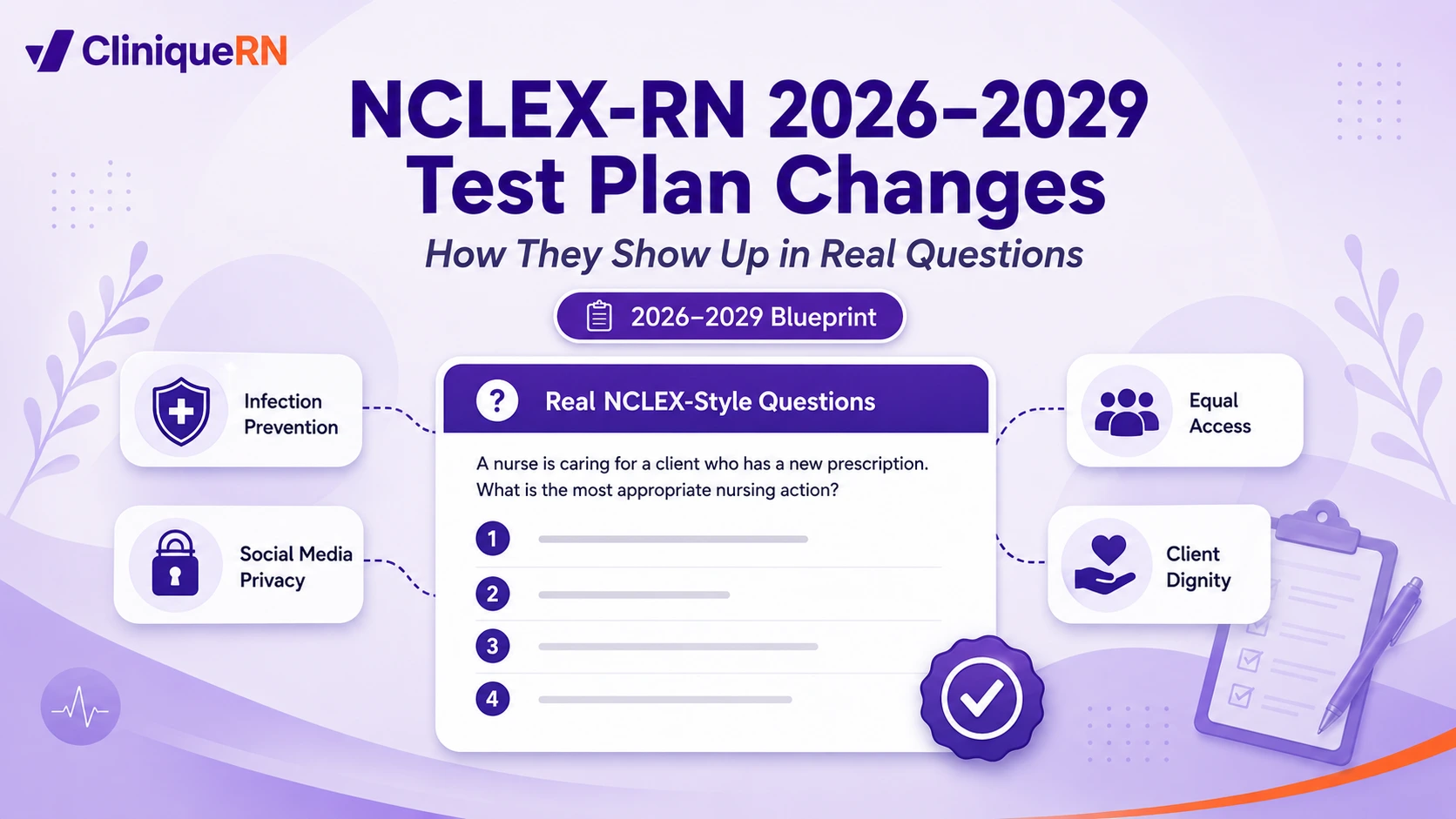
NCLEX-RN 2026–2029 Test Plan: How the Changes Show Up in Actual Questions
If you are taking the NCLEX-RN in 2026 or later, the exam has a new test plan — but it is not a full redesign. The official 2026 NCLEX-RN Test Plan is effective from April 1, 2026 through March 31, 2029. The more useful question is: How could the 2026–2029 test plan changes show up in actual NCLEX-RN questions? That is what this guide focuses on.
Quick Summary: NCLEX-RN 2026–2029 Changes
| Area | What changed? |
|---|---|
| Exam format | No major format change |
| Minimum questions | Still 85 |
| Maximum questions | Still 150 |
| Time limit | Still 5 hours |
| Clinical judgment | Still included |
| Passing standard | Still 0.00 logits through March 31, 2029 |
| Test plan | Updated for 2026–2029 |
| Main category wording change | "Safety and Infection Control" became "Safety and Infection Prevention and Control" |
| Activity statements | Updated based on newer RN practice analysis |
| Notable explicit wording | Equal access, social media privacy, dignity during care, substance misuse, quality and cost-effective care |
This Is Not Just an Announcement Post
Many NCLEX update articles stop at the announcement. This guide goes one step further: it shows what changed, what became more visible, and how those updates can appear in NCLEX-style answer choices. The goal is not panic — it is pattern recognition.
What Did Not Change in NCLEX-RN 2026?
Before we get into the wording updates, here is what students should not worry about. The core exam structure stayed the same:
- 85-question minimum and 150-question maximum
- 5-hour time limit
- Computerized adaptive testing
- Clinical judgment case studies and stand-alone clinical judgment items
- Same major Client Needs framework
- RN passing standard of 0.00 logits through March 31, 2029
So the practical message is simple: keep studying core NCLEX content, but pay closer attention to the updated wording and the nursing judgment behind it.
What Changed in the 2026–2029 NCLEX-RN Test Plan?
The exam format did not change, but the official test plan now makes some nursing responsibilities more explicit.
Only one major category name changed:
Old: Safety and Infection Control
New: Safety and Infection Prevention and Control
This does not mean infection prevention is a brand-new NCLEX topic. It was already tested. The new wording simply makes prevention more visible.
Here are the most important updates students should understand:
| Topic | What the 2026 plan highlights | What it means for NCLEX questions |
|---|---|---|
| Infection prevention | Safety and Infection Prevention and Control | Expect questions about preventing infection before harm occurs, such as hand hygiene, PPE, isolation precautions, sterile technique, and catheter infection prevention. |
| Equal access to care | Unbiased treatment and equal access regardless of culture/ethnicity, sexual orientation, gender identity, or gender expression | Expect advocacy questions where the nurse must respect the client's identity, preferences, support person, or communication needs. |
| Privacy and social media | Confidentiality and privacy, including social media and disclosure of information | Expect questions about social media posts, sharing client details, public conversations, and protecting private health information. |
| Dignity during care | Maintain client dignity and privacy during care | Expect basic care questions about bathing, toileting, perineal care, dressing changes, and exposing only the necessary body area. |
| Substance misuse | Assess for substance misuse and/or toxicities and intervene as appropriate | Expect nonjudgmental communication and safety-focused questions about withdrawal, toxicity, and substance use care. |
| Quality and cost-effective care | Practice and advocate for quality and cost-effective care | Expect questions where the nurse must use resources wisely without delaying care, skipping assessment, or compromising safety. |
| Bedside testing and monitoring | Point-of-care testing, fetal monitoring, and internal monitoring devices | Expect questions about safe testing, monitoring, reporting changes, and staying within RN scope of practice. |
Main takeaway: infection prevention, privacy, dignity, equal access, substance misuse, quality care, and professional nursing judgment are more visible in the 2026–2029 blueprint.
Change 1: Safety and Infection Control Became Safety and Infection Prevention and Control
One of the clearest 2026 wording changes is the category name itself. The new label makes infection prevention more explicit, shifting NCLEX thinking from what to do after infection occurs to what action prevents transmission before harm happens. Students should be ready to apply hand hygiene, standard and transmission-based precautions, PPE, sterile and aseptic technique, and catheter- and surgical-site infection prevention in NCLEX-RN scenarios.
One of the clearest wording changes is the category name. Old wording: Safety and Infection Control. New wording: Safety and Infection Prevention and Control. This does not mean infection prevention is brand new to NCLEX — infection prevention was already tested. But the new wording makes prevention more explicit. That means students should think beyond What do I do after infection occurs? and instead ask: What action prevents infection or transmission before harm happens?
Examples of infection prevention topics
You should be ready for questions about:
- Hand hygiene
- Standard precautions
- Contact precautions
- Droplet precautions
- Airborne precautions
- PPE use
- Sterile technique
- Aseptic technique
- Catheter-associated infection prevention
- Surgical site infection prevention
- Biohazard safety
- Needlestick prevention
- Cleaning and disinfecting equipment
Practice Question 1: Infection Prevention
A nurse is caring for a client with suspected Clostridioides difficile infection who has frequent watery stools. Which action should the nurse take to help prevent transmission?
The correct action is to use soap and water for hand hygiene after client care. C. difficile forms spores, and soap and water mechanically removes these spores from the hands.
This is an infection-control question. The clinical reasoning is to break the chain of infection by stopping fecal-oral spread from contaminated hands, equipment, and surfaces.
The key mechanism is that C. difficile spores are hardy and can survive on surfaces. Alcohol-based hand rubs do not reliably remove or inactivate these spores.
- Use contact enteric precautions.
- Wear gloves and gown for client care.
- Use dedicated equipment when possible.
- Clean the environment with a sporicidal disinfectant.
Clinical pearl: For C. difficile, remember “soap beats sanitizer.” A surgical mask is not the priority because C. difficile is not spread by respiratory droplets.
Change 2: Equal Access and Unbiased Treatment Are More Explicit
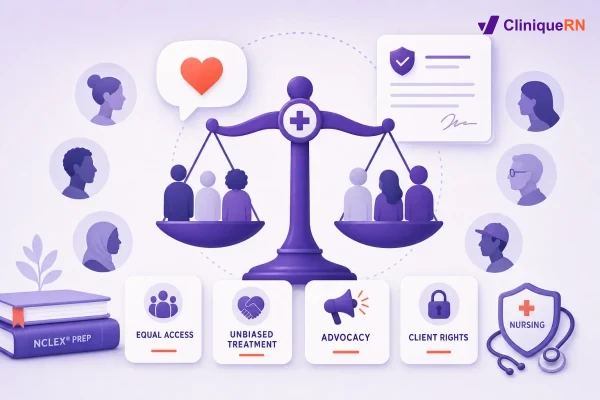
The 2026 NCLEX-RN test plan specifically names equal access regardless of culture, ethnicity, sexual orientation, gender identity, or gender expression. NCLEX scenarios test advocacy through therapeutic communication, interpreter use, client rights, informed consent, respecting identity, and escalating biased or unsafe staff behavior — and the safest answer always protects dignity and access.
One of the most important 2026 updates is the activity statement about providing care that supports: Unbiased treatment and equal access to care. The test plan specifically includes equal access regardless of culture/ethnicity, sexual orientation, gender identity, and gender expression. This is very testable because NCLEX often asks what the nurse should do when a client's rights, dignity, or access to care are at risk. This type of question may show up as therapeutic communication, advocacy, client rights, informed consent, interpreter use, respect for identity and preferences, or escalating biased or unsafe staff behavior.
Practice Question 2: Equal Access to Care
A client tells the nurse, “My partner is my main support person, but the staff keep asking if they are really family.” Which response by the nurse is best?
The best response is to ask the client who they want involved in care and document that preference. This protects client autonomy and supports unbiased, client-centered care.
The clinical reasoning framework is advocacy and ethical/legal care: the client defines their support system, not the nurse, provider, or staff assumptions. Documentation helps the whole team follow the same plan.
There is no medication or pathophysiology mechanism in this question. The key principle is that “family” may include a spouse, partner, friend, or other chosen support person, based on the client’s preference and applicable privacy rules.
Clinical pearl: when staff language or actions suggest bias, the nurse should respond directly, respectfully, and concretely. Asking the client’s preference and documenting it is stronger than simply checking a policy.
The tempting distractor is checking the visitor policy. Policy may matter later, but it does not first validate the client’s concern or establish who the client wants included.
Practice Question 3: Unbiased Treatment
A client tells the health care team their affirmed name and pronouns. The nurse later hears a staff member repeatedly use a different name and pronouns when speaking about the client. Which action should the nurse take?
The correct action is to use the client’s stated name and pronouns and remind staff to do the same. This protects the client’s dignity, supports trust, and promotes unbiased care.
The clinical reasoning is based on psychosocial integrity and culturally responsive communication. When the nurse recognizes disrespectful communication, the best solution is to correct the environment rather than wait for the client to be harmed or complain.
There is no drug or disease mechanism in this question. The key clinical concept is that repeated misnaming or misgendering can increase distress, reduce trust, and make clients less likely to communicate openly with the health care team.
Clinical pearl: the client is the authority on their own name and pronouns. Do not ask family members to decide for the client when the client has already stated their preference.
The tempting distractor is to avoid using names or pronouns, but avoidance does not solve the problem. Respectful, direct use of the client’s stated identifiers is more therapeutic and clinically appropriate.
Practice Question 4: Language Access
A preoperative client with limited English proficiency is preparing to sign an informed consent form for surgery. The client’s adult child offers to interpret the consent discussion. Which action should the nurse take?
The correct action is to arrange for a qualified medical interpreter before the client signs. A client cannot give valid informed consent unless the information is communicated in a language the client can understand.
This question uses an ethical-legal nursing framework: protect the client’s autonomy, right to informed decision-making, and access to safe communication. The nurse should not witness a consent signature if the client’s understanding has not been ensured.
The key concept is not pathophysiology or medication action; it is communication access. Accurate interpretation helps the client understand the procedure, risks, benefits, alternatives, and the right to refuse.
Clinical pearl: family members should not be used as the primary interpreter for surgical consent because they may make errors, filter information, or influence the client’s decision.
The tempting distractor is asking the adult child to translate “only the parts the client does not understand.” This still fails because the nurse cannot know what was misunderstood, omitted, or inaccurately interpreted.
Change 3: Privacy Now Clearly Includes Social Media and Digital Disclosure
The 2026 test plan explicitly names social media and disclosure of information under confidentiality. NCLEX scenarios test whether students can spot privacy breaches even when names are removed — for example, posts that include diagnosis, age, unit, time, or circumstance can re-identify a client. The correct answer follows facility policy and protects confidentiality.
The 2026 test plan explicitly mentions confidentiality and privacy examples such as social media and disclosure of information. This is a strong NCLEX scenario area. Students should expect questions about posting client stories online, sharing "de-identified" client details, taking photos in clinical areas, discussing clients in elevators or public spaces, sending client information to the wrong person, and looking up records without a care-related reason. Even if a nurse does not use the client's name, the post can still be a privacy breach if the client could be identified by details.
Practice Question 5: Social Media Privacy
A nurse notices a coworker’s social media post stating, “Long shift with a young trauma client after a motorcycle crash. So sad.” The post does not include the client’s name or photograph, but it includes the hospital unit and time of admission. Which action should the nurse take?
The correct action is to follow facility policy for reporting a possible confidentiality breach. Even without a name or photo, details such as the unit, time of admission, age description, diagnosis, and circumstances can identify a client.
The clinical reasoning framework is ethical-legal nursing practice: protect the client’s privacy, use the chain of command, and follow policy rather than handling the issue informally or publicly.
The key concept is that PHI is more than a name. Any information that could reasonably identify a client must be protected.
Clinical pearl: Social media posts about client care are risky when they include specific timing, location, diagnosis, injury, or unusual circumstances.
The most tempting wrong answer is to comment on the post and tell the coworker to remove it. That may increase public attention and does not replace the required reporting process.
Change 4: Client Dignity and Privacy During Care Are More Visible
The 2026 test plan names dignity and privacy during care as an explicit activity statement. NCLEX does not only test dramatic emergencies; it also tests safe, respectful routine care such as bathing, toileting, perineal care, dressing changes, catheter care, postmortem care, and mobility assistance. The safest answer explains the procedure, closes the door or curtain, drapes the client, exposes only the area needed, and respects preferences.
The 2026 test plan also includes maintaining client dignity and privacy during care. This is important because NCLEX does not only test dramatic emergencies — it also tests safe, respectful routine care. Dignity and privacy can appear in questions about bathing, toileting, perineal care, dressing changes, catheter care, postmortem care, mobility assistance, and care for clients with sensory or physical impairment. The safest nursing action usually includes explaining the procedure, closing the curtain or door, exposing only the area needed, and respecting the client's preferences.
Practice Question 6: Dignity During Care
An older adult client requires assistance with perineal hygiene. Which nursing action best maintains the client’s dignity during care?
The best action is to provide privacy, explain the care, and expose only the area being cleaned. This protects the client’s dignity because perineal care is intimate and can cause embarrassment, vulnerability, or loss of control.
The clinical reasoning is based on patient-centered basic care: meet the hygiene need while preserving privacy, modesty, and autonomy. The nurse should tell the client what will happen, allow participation as able, and keep the client covered as much as possible.
There is no medication or disease mechanism in this question. The key concept is psychosocial: intimate care can increase anxiety when a client feels exposed or powerless.
Clinical pearl: During any intimate procedure, protect the client’s body and choices. Ask permission, close doors or curtains, use draping, and explain each step before touching the client.
The most tempting distractor is involving family for reassurance. Family may help only if the client wants them present; otherwise, their presence can reduce privacy rather than support dignity.
Change 5: "Substance Abuse" Is Updated to "Substance Misuse"
The 2026 wording shift toward substance misuse is more neutral, professional, and stigma-free. The nursing concept is unchanged — assess, intervene, support, recognize withdrawal or toxicity, and promote safety — but the language matters. NCLEX-RN 2026 answers should use clinical terms like substance use disorder, withdrawal, and substance misuse, and should avoid judgmental labels.
Another wording update is the shift toward substance misuse. This matters because NCLEX wording is moving toward more neutral, professional, and stigma-free language. The nursing concept is still similar: the nurse must assess, intervene, provide support, recognize withdrawal or toxicity, and promote safety. But the language matters. Avoid thinking in judgmental labels such as "drug abuser," "addict," or "noncompliant because they use drugs." Think in professional language such as "client with substance use disorder," "client experiencing withdrawal," "client with substance misuse," or "client needs assessment and support."
Practice Question 7: Substance Misuse and Therapeutic Communication
A client admitted for opioid withdrawal says, “I know the nurses probably think this is my fault.” Which response by the nurse is most therapeutic?
The best response is the one that acknowledges the client’s distress and offers nonjudgmental support: withdrawal is difficult, and the nurse is present to help the client stay safe.
This question uses the therapeutic communication framework: validate first, avoid stigma, and focus on safety. The client is expressing shame and fear of judgment, so the nurse should not correct, minimize, or redirect too quickly.
Opioid withdrawal occurs when opioid levels fall in a person who has developed physiologic dependence. The nervous system becomes overactive, causing symptoms such as anxiety, restlessness, muscle aches, sweating, nausea, vomiting, diarrhea, and insomnia.
Clinical pearl: opioid withdrawal is usually not life-threatening by itself, but it can cause severe distress, dehydration, relapse risk, and safety concerns. Nurses should monitor symptoms, hydration, mental status, and suicide risk when indicated.
The most tempting distractor is the response about guilt and recovery. It sounds supportive, but it labels the client’s feeling as guilt and can reinforce shame instead of directly validating the client’s current concern.
Change 6: Quality and Cost-Effective Care
The 2026 activity statement asks nurses to practice and advocate for quality and cost-effective care. The key point is that cost-effective care never means unsafe care. Correct NCLEX-RN 2026 answers cluster routine care for stable clients, conserve supplies, and delegate appropriately — but they never delay urgent treatment, skip necessary assessments, or reduce quality to save time or resources.
The 2026 test plan includes the activity statement: Practice and advocate for quality and cost-effective care. This means the nurse should use resources responsibly while still protecting client safety and quality of care. The key point is: Cost-effective care never means unsafe care. A correct answer should not delay urgent treatment, skip a necessary assessment, or reduce quality just to save time or resources.
Practice Question 8: Quality and Cost-Effective Care
A nurse is planning care for several clients on a busy medical-surgical unit. Which nursing action best promotes quality, cost-effective care?
The correct action is to cluster routine care for a stable client while still completing required assessments. This saves time and reduces interruptions without skipping essential nursing responsibilities.
The clinical reasoning framework is safety before efficiency. Cost-effective care is appropriate only when it maintains assessment, infection prevention, medication safety, and client outcomes.
The key mechanism behind this question is that missed or delayed care can create complications. For example, a saturated dressing can lead to skin maceration, bacterial growth, and missed signs of bleeding or infection.
Clinical pearl: efficiency is never a reason to delay urgent assessment, ignore medication timing, or delegate nursing judgment. A new report of shortness of breath is a breathing concern and requires nurse assessment.
The most tempting distractor is delegating the new shortness of breath report to assistive personnel. That may seem time-saving, but initial assessment of a new or changing condition cannot be delegated.
Change 7: Bedside Testing and Monitoring Are More Visible
The 2026–2029 test plan also makes bedside testing and monitoring more visible. This includes point-of-care testing, fetal monitoring, and internal monitoring devices. For NCLEX purposes, this does not mean you need to memorize every device detail. It means you should recognize what safe nursing judgment looks like when test results or monitor data are available at the bedside.
In questions, expect the nurse to verify the client, follow policy, recognize abnormal results, report urgent changes, document clearly, and stay within RN scope. The safest answer will not ignore a critical value, delay assessment, delegate interpretation of an unstable finding, or treat monitor data as more important than the client’s actual condition.
So, Are These Really "New" NCLEX Questions?
Not exactly. Many of these concepts were already part of safe nursing care. What changed is that the 2026–2029 test plan makes some areas easier to see in the wording. Students should expect modern NCLEX-RN scenarios involving client rights, advocacy, equal access, therapeutic communication, privacy, social media, infection prevention, dignity during care, nonjudgmental language, cost-effective care, bedside monitoring, and safe escalation of concerns.
How to Study for the 2026–2029 NCLEX-RN Test Plan
- Do not study only the announcement. Practice how the changes look inside questions. For example, instead of only memorizing that 'Safety and Infection Control' became 'Safety and Infection Prevention and Control,' ask which PPE is needed, which action prevents transmission first, and what breaks sterile technique.
- Practice advocacy and equal access questions. Be ready for scenarios where the nurse must protect a client's rights — answers should respect preferences, use qualified interpreters, include the client in decisions, avoid assumptions, support unbiased care, and escalate discriminatory or unsafe behavior.
- Practice privacy questions with social media. Social media questions are likely to be scenario-based. The correct answer usually maintains confidentiality, reports through proper policy, avoids public discussion, and recognizes that missing names do not always make a post safe.
- Practice dignity questions in basic care. Questions about bathing, toileting, wound care, postmortem care, and dressing changes can test dignity and privacy. Choose answers that explain the procedure, close the door or curtain, drape the client, expose only what is necessary, and respect client preferences.
- Use professional, nonjudgmental language. When answering psychosocial or substance-related questions, choose responses that are therapeutic, nonjudgmental, supportive, safety-focused, and client-centered. Avoid answers that shame, blame, lecture, or label the client.
- Remember that cost-effective care must still be safe. Cost-effective care does not mean doing less care — it means using resources wisely while still providing safe, quality nursing care. Choose answers that protect client safety, required assessments, infection prevention, timely intervention, appropriate delegation, and evidence-based care.
- Treat bedside testing and monitoring as nursing-judgment questions. Verify the client, assess the whole client, recognize abnormal results, report urgent changes, and avoid delegating interpretation of unstable findings.
The real NCLEX skill is not memorizing what changed — it is practicing how those changes appear in questions.
NCLEX Study Strategy
Key Takeaways from the 2026–2029 NCLEX-RN Test Plan
- The NCLEX-RN 2026 changes are a test plan refresh, not a complete exam redesign — format, question range, clinical judgment structure, and passing standard are largely unchanged.
- "Safety and Infection Control" became "Safety and Infection Prevention and Control" — think prevention-first actions like hand hygiene, PPE, and transmission-based precautions.
- Unbiased treatment and equal access to care are now explicit, regardless of culture, sexual orientation, gender identity, or gender expression.
- Privacy now clearly includes social media and digital disclosure — even "de-identified" details can breach confidentiality.
- Dignity and privacy during basic care are testable in bathing, toileting, perineal care, dressing changes, and postmortem care.
- Substance misuse has replaced more stigmatizing wording — use neutral, professional, client-centered language.
- Cost-effective care must never compromise safety, assessment, infection prevention, or quality of care.
- Bedside testing and monitoring questions still come back to safe nursing judgment: verify, assess, recognize abnormal findings, report, and document.
Final Takeaway
The NCLEX-RN 2026–2029 update is not a brand-new exam. The format, question range, clinical judgment structure, and passing standard are largely unchanged. But the wording updates matter because they show what current entry-level RN practice emphasizes: infection prevention, equal access to care, unbiased treatment, social media privacy, client dignity during care, substance misuse, quality and cost-effective care, and safe use of current testing and monitoring practices. The best way to prepare is to practice how those changes appear in actual NCLEX-style questions.